

Glass Options
Insulated Glass (DGU)
Two panes with a sealed air or argon cavity — the core of an energy-efficient window.
Two glass panes separated by a spacer and hermetically sealed, with dry air or argon in the cavity. The trapped gas is a poor conductor, so heat transfer drops sharply and the inner pane stays closer to room temperature — which also stops condensation.
Pair a low-E coated outer pane with an acoustic laminated inner pane and you get heat and noise handled in one unit.
Key highlights
- Sealed air or argon cavity
- Large drop in heat transfer
- Eliminates winter condensation
- Combine with low-E or laminated panes
- Available with integral blinds
Technical specification
| Build-up | 5+12+5, 6+12+6, 5+20+5 and custom |
|---|---|
| Cavity fill | Dry air or argon |
| Spacer | Aluminium or warm-edge, with desiccant |
| Best for | Any room where cooling cost or noise matters |
Frequently asked questions
uPVC insulates far better and costs less for ordinary residential openings. Thermally broken aluminium is stronger, so it carries larger panels with slimmer frames. We usually specify uPVC for bedrooms, kitchens and bathrooms, and aluminium for very large sliders, stairwell glazing and anything above about 2.4 metres tall.
Not if the profile is UV stabilised and lead-free, which ours are. Yellowing happens with cheap unstabilised profile or recycled material. We supply a written warranty against discolouration.
An acoustic laminated inner pane inside a double-glazed unit, with the two panes at different thicknesses and a wide cavity. Just as important, choose a casement or tilt-and-turn window rather than a slider, because the sash needs to compress onto its gaskets to seal.
Yes. We bend profile on a heated forming table from a site template, so semi-circular, segmental and elliptical heads are all possible, fixed or with an operable lower sash.
You may also like
More from Glass Options
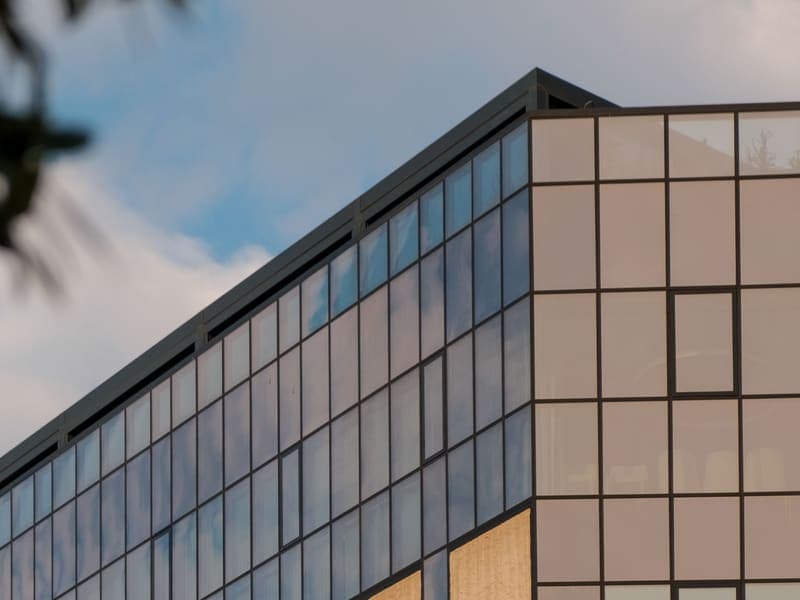
Float Glass
Standard clear glazing where thermal, acoustic and safety demands are modest.
View details
Tinted Glass
Body-tinted glass that absorbs solar radiation and cuts glare.
View details
Reflective Glass
Metallic-coated glass that reflects solar heat and gives daytime privacy.
View details
Toughened Glass
Heat-treated safety glass, four to five times stronger, that crumbles instead of shattering.
View details